

Conveyor idlers are often treated as standard components, but selecting the correct idler requires more than simply matching the belt width. A 1,200 mm conveyor carrying coal indoors may require a very different idler from a 1,200 mm conveyor transporting iron ore in an outdoor mining environment.
The correct selection should consider belt width, belt speed, capacity, material characteristics, loading conditions, impact, idler spacing, roll diameter, bearing capacity, sealing and operating environment as a complete system.
For international projects, ISO 1537:1975 provides requirements for the dimensions, arrangement and clearance of three-roll idlers used on troughed belt conveyors. The standard was reviewed and confirmed by ISO in 2025 and remains current. CEMA provides a more detailed engineering approach for evaluating idler load, roll diameter, spacing, bearing life and conveyor operating conditions.
The following method can be used to quickly narrow down the appropriate conveyor idler specification.
The first step is to determine where the idler will be installed and what function it performs.
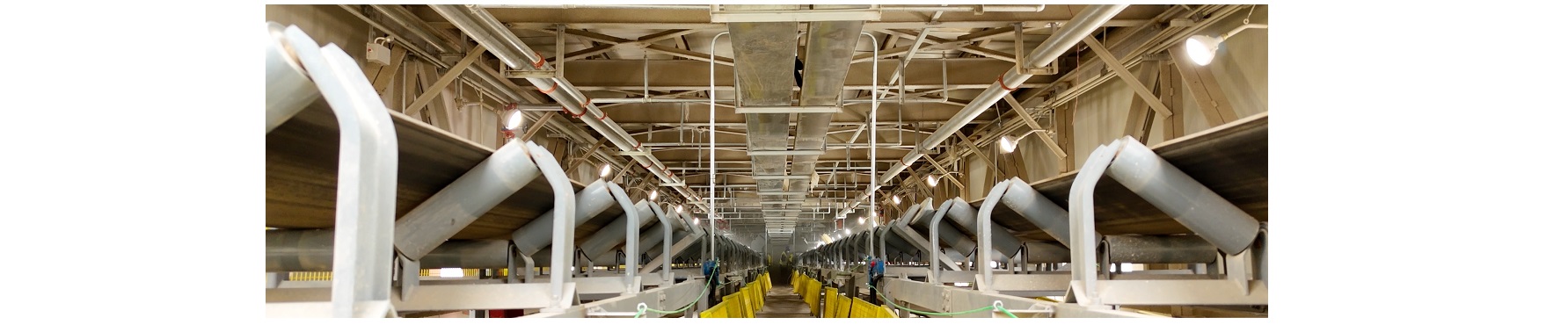
Carrying idlers support the loaded belt and are commonly arranged as three-roll or five-roll troughing idlers. Return idlers support the empty belt on the return run and may use single-roll, V-return or self-cleaning designs. Impact idlers are installed below loading points where falling material produces concentrated impact. Transition idlers are used near the head and tail pulleys to gradually change the belt from a flat profile to a troughed profile.
These positions should not be treated as interchangeable. A heavy-duty carrying idler does not automatically provide the impact protection required at a loading point.
Belt width establishes the basic dimensions of the idler and frame. Common conveyor belt widths include 650, 800, 1,000, 1,200, 1,400, 1,600 and 1,800 mm.
However, belt width alone does not determine the final idler model. A 1,200 mm belt can be used for light-duty material as well as high-capacity mineral handling, so the idler load and operating conditions must be checked separately.
Belt speed affects the rotational speed of the idler roll. The approximate roll speed is:
n = 60v / πD
where n is roll speed in rpm, v is belt speed in m/s, and D is roll diameter in metres.
For example, at a belt speed of 3 m/s, a 108 mm roll rotates at approximately 530 rpm, while a 159 mm roll rotates at approximately 360 rpm.
Therefore, high-speed conveyors generally require careful consideration of roll diameter, bearing speed, sealing and rotational resistance. CEMA's engineering data also demonstrates the relationship between roll diameter and predicted bearing life.
Capacity is normally specified in t/h or m³/h. A higher capacity generally means a higher material load per metre of belt, which increases the load carried by each idler.
Capacity should therefore be evaluated together with bulk density. For example, 1,500 t/h of coal and 1,500 t/h of iron ore do not create the same loading condition because their bulk densities are substantially different.
The material specification should include more than its name. Ideally, provide bulk density, maximum lump size, moisture condition and abrasiveness.
Maximum lump size is particularly important at loading points. A material with a typical particle size of 50 mm may still contain occasional 300 or 400 mm lumps. The impact idler should be selected according to the actual worst-case loading condition rather than the average particle size.
Idler load depends on the weight of the belt, the material load and the spacing between idlers. Increasing the spacing reduces the number of idlers but increases the load carried by each idler.
Loading points require additional attention because falling material can generate short-duration impact loads much higher than the normal distributed load. CEMA's idler selection material treats impact idlers separately and uses different spacing and load considerations for impact zones.
Environmental conditions directly affect bearing and seal life. For conveyors installed at the seaside, in ports, chemical plants or high-humidity areas, corrosion resistance and water protection should be considered together with dust protection. In dusty applications such as coal, cement and mining, the sealing system is often more important than simply increasing bearing size.
For hazardous areas, the conveyor system must also comply with the applicable explosion-protection requirements for the specific site classification. “Explosion-proof idler” should not be treated as a substitute for a complete system-level safety assessment.
| Conveyor Idler Selection Criteria & Duty Specifications | ||
| Light / Normal Duty | Heavy Duty / High Speed | Severe Duty |
| Smaller standard diameter may be sufficient | Larger diameter often preferred | Large diameter with higher load capacity |
| Normal spacing | Reduce spacing if required by load | Shorter spacing, especially at loading points |
| Standard service life | Higher load/speed rating | Heavy-duty bearing with verified L10 life |
| Standard dust protection | Enhanced sealing | Dust- and water-resistant multi-stage sealing |
| Standard steel tube | Increased wall thickness if required | Reinforced tube for high impact and abrasive service |
| Standard coating | Protective coating | Coating, galvanizing or corrosion-resistant materials according to environment |
| Indoor bulk handling | High-speed or high-capacity conveyors | Mining, severe impact, wet, dusty or corrosive conditions |
A larger roll diameter reduces rotational speed at the same belt speed and can improve bearing life and roll wear performance. However, larger is not automatically better because it also increases component weight, dimensions and cost.
The correct choice is a balance between belt speed, idler load, bearing life, roll resistance and service conditions.
Idler spacing has a direct effect on the load per idler. If the spacing is increased, each idler supports a longer section of loaded belt.
As a practical starting point, carrying idlers in many conventional bulk-material conveyors may be spaced around 1.0–1.5 m, but this should never be treated as a universal rule. The final spacing should be calculated from belt and material weight, idler load rating, belt sag requirements and the applicable design standard.
Loading zones normally require substantially closer spacing and impact idlers.
For clean indoor applications, a standard multi-stage sealing arrangement may be adequate. Dusty environments require better protection against fine particles, while wet environments require effective water exclusion.
A common mistake is to specify a larger bearing when the real problem is inadequate sealing. A high-capacity bearing cannot compensate for contamination entering the bearing system.
Standard painted steel is suitable for many indoor applications. Mining and abrasive-material applications may require stronger tubes and adequate wall thickness rather than simply changing the material to stainless steel.
For coastal, port, chemical or continuously wet environments, the required protection may include enhanced coatings, galvanizing or corrosion-resistant components. The choice should be based on the actual corrosive medium, temperature and expected service life.
| Conveyor Operating Conditions & Recommended Selection Approach | |
| Operating Condition | Recommended Selection Approach |
| Normal indoor bulk material | Standard troughing idler with suitable sealing |
| High-speed conveyor | Check roll diameter, bearing speed and service life |
| High-capacity conveyor | Increase load rating and verify idler spacing |
| Large lump material | Heavy-duty impact idlers at loading points |
| High-density material | Higher idler load rating and appropriate spacing |
| Heavy dust | Enhanced multi-stage sealing |
| Wet or humid environment | Water-resistant sealing and corrosion protection |
| Sticky material | Self-cleaning rubber-disc or spiral return idler |
| Loading point | Impact idler or engineered impact-support system |
| Head/tail transition | Transition idler with appropriate transition geometry |
| Hazardous area | Apply the project's applicable explosion-protection requirements |
Consider a conveyor with the following conditions:
Belt width: 1,200 mm
Belt speed: 2.5 m/s
Capacity: 1,500 t/h
Material: Coal
Bulk density: approximately 0.8 t/m³
Maximum lump size: approximately 150 mm
Environment: Indoor, dusty but not corrosive
Carrying idler spacing: approximately 1.2 m
The first choice would normally be a three-roll troughing idler suitable for a 1,200 mm belt.
At 2.5 m/s, a 108 mm roll runs at approximately 442 rpm, while a 159 mm roll runs at approximately 301 rpm. Because this is a continuous bulk-handling application with significant capacity, the larger roll diameter may provide a more suitable balance of rotational speed, bearing life and durability.
The final specification should therefore be developed around:
1,200 mm belt + three-roll troughing idler + approximately 159 mm roll + suitable heavy-duty bearing and dust sealing + approximately 1.2 m spacing, subject to final load calculations.
The important point is that the specification is determined by the complete operating condition, not by the belt width alone.
Now consider a more severe application:
Belt width: 1,400 mm
Belt speed: 3.5 m/s
Capacity: 3,000 t/h
Material: Iron ore
Bulk density: approximately 2.0 t/m³
Maximum lump size: 400 mm
Environment: Outdoor mining application with heavy dust
Loading: Large impact at the transfer point
This conveyor carries much denser material at a higher speed and capacity. The carrying section therefore requires a higher-load idler design with careful verification of roll diameter, bearing life and spacing.
The transfer point is a separate problem. A 400 mm lump falling onto the belt can generate significant impact, so a standard carrying idler should not simply be used in this area. A heavy-duty impact idler, with closer spacing and suitable impact absorption, should be specified.
Because the conveyor operates outdoors in a dusty mining environment, the sealing system should also provide strong dust protection, while the external components require appropriate corrosion protection.
This example shows why one conveyor can require several different idler configurations along its length.
The most common mistake is selecting an idler only by belt width. Other frequent errors include ignoring material density, using average particle size instead of maximum lump size, selecting a small roll diameter for a high-speed conveyor, using the same idler throughout the conveyor, increasing bearing size without improving sealing, and copying an idler specification from an older project without checking whether the new capacity or operating conditions have changed.
Another common mistake is treating impact idlers as simply “stronger carrying idlers.” Their purpose is to manage concentrated impact at loading points, so the impact condition, spacing and support structure must be considered together.
For most projects, the selection process can be simplified to eight steps:
1. Confirm belt width.
Determine the basic idler and frame dimensions.
2. Confirm belt speed.
Use the maximum operating speed to check roll rotational speed.
3. Confirm capacity.
Determine the material loading per metre of belt.
4. Define the material.
Check bulk density, maximum lump size, moisture and abrasiveness.
5. Calculate idler load.
Consider belt weight, material weight and idler spacing.
6. Select roll diameter.
Balance load, speed, bearing life and operating resistance.
7. Select spacing, bearing and sealing.
Match them to the calculated load and environment.
8. Check special conditions.
Review impact, dust, water, corrosion, temperature, hazardous-area requirements and operating hours.
A technically useful inquiry should provide at least:
Belt width, belt speed, capacity, material, bulk density, maximum lump size, carrying-idler spacing, return-idler spacing and operating environment.
If available, also provide belt weight, belt tension, troughing angle, conveyor length, ambient temperature and operating hours per day.
With these data, the supplier can select an idler based on the actual application instead of simply matching a catalogue dimension.
Accurate conveyor idler selection is not a matter of choosing a roller that fits the belt. It is a process of matching the idler to the load, speed, material, impact and environment.
The basic selection logic is straightforward:
Belt width → basic dimensions
Capacity + material density → loading
Belt speed → roll speed
Lump size + drop condition → impact requirement
Spacing → load per idler
Dust / water / corrosion → sealing and protection
Continuous operation → bearing life and durability
A complete idler specification should therefore define the idler type, belt width, roll diameter, load/bearing class, spacing, sealing and material or surface protection.
This approach allows engineers and purchasers to compare different suppliers on the basis of actual operating requirements rather than simply comparing the price of a single “1200 mm idler.” It also provides a much more reliable way to prevent premature bearing failure, seal damage, excessive roll wear and unnecessary maintenance.
Contact: Export Department
Phone: +86 15097752737
Tel: +86 0312 5308005
Company: Baoding Zhuoli Machinery Co.,Ltd
Add: 3934 Tower3,Weilaishi building,Xiongan New Area.Baoding city,China