

In the engineering design and procurement of heavy-duty belt conveyor systems, the anti-corrosion strategy for frames is directly linked to operational stability and maintenance costs. As structural components, the choice typically lies between Industrial Painting and Hot-Dip Galvanizing (HDG).
This guide provides an objective technical analysis based on corrosion mechanisms, operational applicability, and cost-effectiveness to assist engineers and procurement decision-makers.
Correct selection begins with understanding the nature of protection.
Industrial Painting: The Physical Barrier
Mechanism: A coating system (Primer + Intermediate + Topcoat) forms a film to block water, oxygen, and corrosive agents.
Nature: "Passive Protection." Effectiveness relies entirely on coating integrity.
Risk: Under vibration or impact, micro-cracks can form. Once the film is breached, "under-film corrosion" spreads rapidly, leading to failure.
Hot-Dip Galvanizing (HDG): Metallurgical Bond & Sacrificial Anode
Mechanism: Steel is immersed in molten zinc, forming a zinc-iron alloy layer via solid-state diffusion.
Nature: "Active Protection." The zinc layer forms a metallurgical bond (up to 6000 psi) with the steel. Crucially, zinc acts as a Sacrificial Anode (Cathodic Protection), oxidizing preferentially to protect the steel if the coating is scratched.
Risk: Requires precise control during manufacturing to manage welding stress and prevent heat distortion in thin-walled parts.
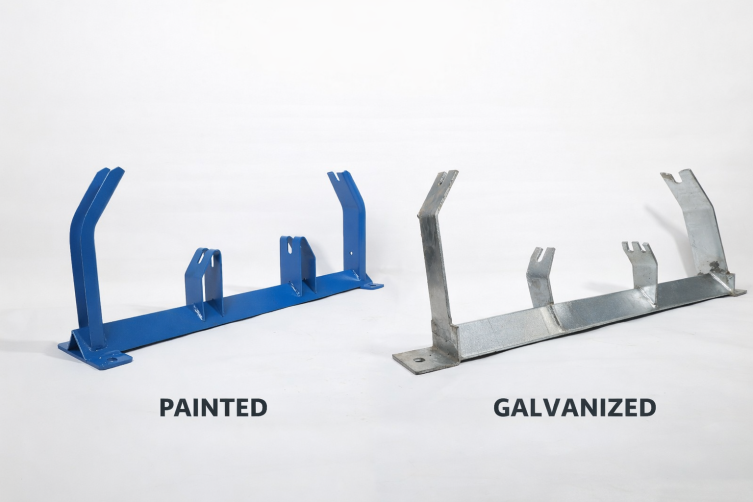
Based on engineering experience, we recommend selecting based on the specific environment:
Choose Hot-Dip Galvanizing (HDG) If:
High Corrosivity: Environments with high salinity, humidity, or chemical exposure (e.g., Ports, Coastal Plants, Open-pit Mines).
Dynamic Loads & Vibration: Ideal for transfer stations and loading points. The HDG alloy layer is harder than base steel, offering superior resistance to vibration fatigue and abrasion.
Low Maintenance Accessibility: Areas where re-painting is difficult or costly, such as long-distance overland conveyors or high-elevation gantries.
Complex Geometries: For C-channels welded back-to-back or truss structures where spray guns cannot reach. Liquid zinc ensures 100% coverage of internal cavities and edges.
Choose Industrial Painting If:
Indoor & Dry Environments: Enclosed factories or warehouses where corrosion risk is negligible.
High Dimensional Precision: Components requiring tight tolerances where heat distortion from HDG is unacceptable.
Specific Color Coding: Projects requiring safety yellow, red, or specific branding colors (Note: HDG can be painted, but adds cost).
Short-Term Projects: Temporary lines with a service life under 5-8 years.
Decisions should shift from "Initial Investment" to "Total Cost of Ownership (TCO)."
The Cost Dynamic:
Initial Cost: HDG is typically 15-30% more expensive than a standard 3-coat paint system (depending on zinc prices and steel thickness).
Maintenance Cost: Painted frames in outdoor environments often require touch-ups or repainting every 5-7 years. The cost of downtime, labor, and access for a single maintenance cycle often exceeds the initial price difference.
Our Recommendation:
For Long-Term Outdoor Projects: Prioritize HDG. The slightly higher upfront cost is an investment in a "maintenance-free" solution that significantly lowers TCO.
For Budget-Sensitive or Indoor Projects: Choose Painting, but strictly enforce specifications in the technical agreement:
Surface Preparation: Mandatory Sa 2.5 Shot Blasting. Painting directly over mill scale is the #1 cause of early failure.
Film Thickness: Define clear Dry Film Thickness (DFT) and adhesion testing standards.
Regardless of the chosen method, quality lies in the execution.
For HDG: Manufacturers must optimize vent and drain hole layouts during the detailing phase to prevent distortion and ensure zinc thickness meets ISO 1461 or ASTM A123 standards.
For Painting: Strict control of environmental humidity and overcoating intervals is essential to ensure chemical bonding between the primer, substrate, and subsequent layers.
Selecting between HDG and Painting is not just a price comparison—it is a balance between environmental endurance and operational costs. For outdoor and heavy-duty conditions, Hot-Dip Galvanizing is the superior choice for structural safety due to its sacrificial protection. For controlled indoor environments, high-standard Industrial Painting offers a flexible, economic alternative.

Contact: Export Department
Phone: +86 15097752737
Tel: +86 0312 5308005
Company: Baoding Zhuoli Machinery Co.,Ltd
Add: 3934 Tower3,Weilaishi building,Xiongan New Area.Baoding city,China